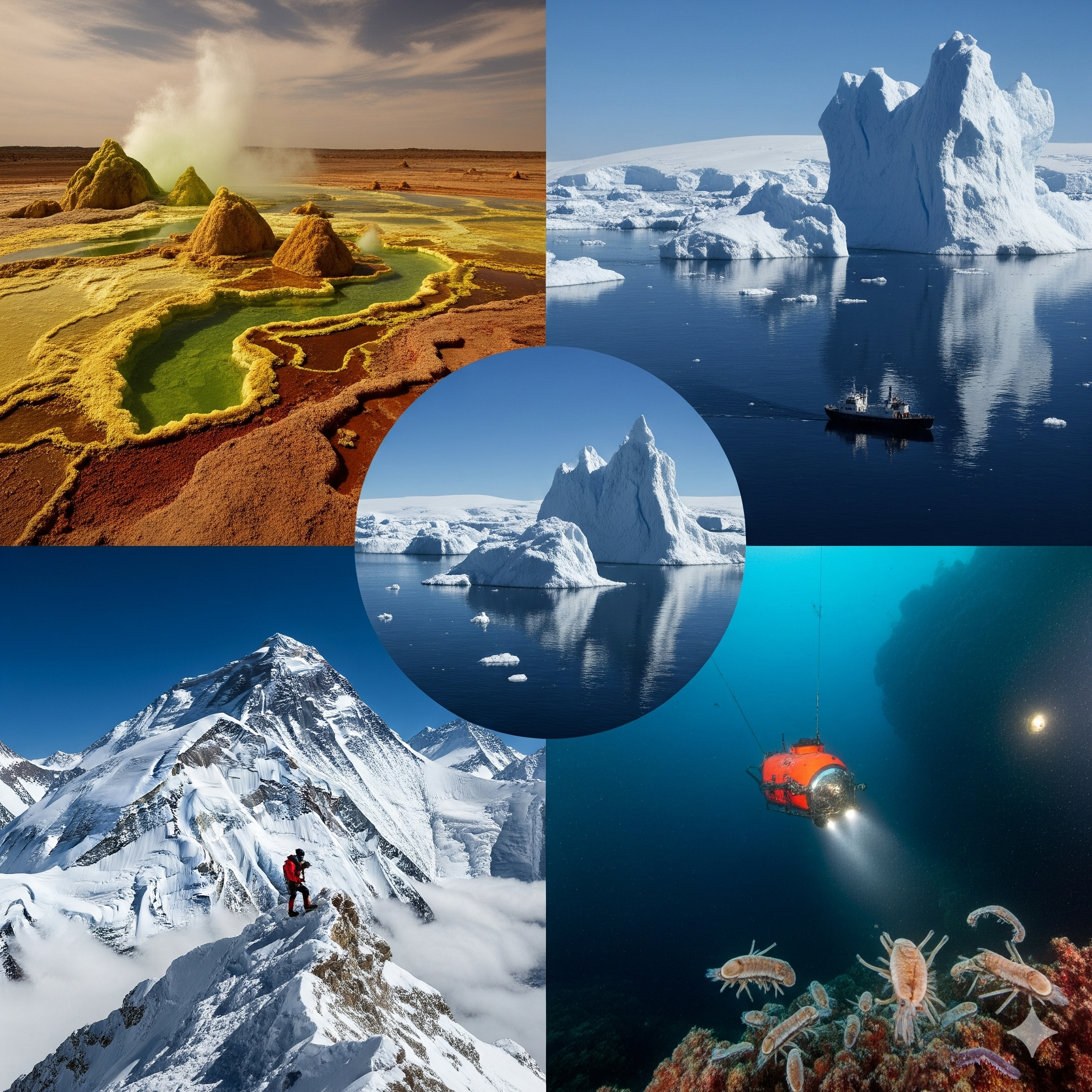
Our planet is a place of incredible diversity, a vibrant tapestry woven with lush forests, vast oceans, and towering mountain ranges. But within this beautiful mosaic lie hidden pockets of extreme conditions – places where nature pushes the boundaries of what life can endure. From scorching deserts to icy poles, and from dizzying heights to crushing depths, these are the world’s most extreme places, offering a fascinating glimpse into Earth’s raw power and the remarkable resilience of life.
The Scorching Sands: Death Valley, USA
When we think of extreme heat, one place immediately springs to mind: Death Valley. Nestled in the Mojave Desert of eastern California, this aptly named valley holds the record for the highest air temperature ever recorded on Earth. On July 10, 1913, the mercury soared to a blistering 56.7 °C (134 °F) at Furnace Creek.
The valley’s extreme temperatures are due to a combination of factors: its low elevation (Badwater Basin, the lowest point in North America, lies 86 meters (282 feet) below sea level), the lack of vegetation, and its surrounding mountain ranges that trap hot air. Yet, even in this furnace, life persists. Hardy creosote bushes dot the landscape, and the elusive desert pupfish thrives in saline pools, a testament to adaptation in the face of incredible odds.
The Frozen Frontier: Vostok Station, Antarctica
From searing heat, we plunge into the icy grip of the Earth’s coldest place: Vostok Station, Antarctica. Located deep within the East Antarctic Ice Sheet, this Russian research station holds the record for the lowest natural temperature ever directly recorded on Earth. On July 21, 1983, the thermometer plummeted to an unimaginable -89.2 °C (-128.6 °F).
Imagine breathing air so cold it feels like shards of glass in your lungs. The immense altitude (3,488 meters or 11,444 feet above sea level), the permanent ice cover reflecting solar radiation, and the absence of any moderating ocean influence contribute to Vostok’s unparalleled chill. Scientists here brave these conditions to study Earth’s ancient climate through ice core drilling, offering crucial insights into our planet’s past and future. Despite the extreme cold, microscopic life forms have been found within the subglacial Lake Vostok, proving that even in the most desolate environments, life finds a way.
Reaching for the Sky: Mount Everest, Nepal/China
The dream of “standing on top of the world” draws adventurers to the majestic Himalayas, home to Mount Everest. At a staggering 8,848.86 meters (29,031.7 feet) above sea level, its summit is the highest point on Earth. Scaling Everest is an ultimate test of human endurance, demanding incredible physical and mental fortitude.
The “death zone” above 8,000 meters presents an unforgiving environment with dangerously low oxygen levels, extreme cold, and unpredictable weather. Yet, the allure of the summit continues to inspire. The unique ecology of the high Himalayas also supports fascinating life, with high-altitude adapted plants and animals like the elusive snow leopard thriving in these thin air environments.
The Deepest Abyss: Challenger Deep, Mariana Trench
While we marvel at the heights, the Earth also conceals unfathomable depths. The deepest known point in the Earth’s oceans, and indeed on Earth, is the Challenger Deep, located in the western Pacific Ocean at the southern end of the Mariana Trench. Here, the ocean floor plunges to an astonishing 10,984 meters (36,037 feet) below sea level.
The pressure at this depth is immense – over 1,000 times the atmospheric pressure at sea level – enough to crush most conventional submersibles. Temperatures hover just above freezing, and sunlight never penetrates. Yet, even in this perpetually dark, cold, and high-pressure environment, life flourishes. Strange and wonderful creatures, from amphipods to tiny fish, have adapted to these extreme conditions, demonstrating the incredible adaptability of life on Earth. These discoveries continue to challenge our understanding of biological limits and the potential for life in extreme environments.
Other Notable Extremes:
The Driest Place: The Atacama Desert in Chile, with some areas receiving virtually no rainfall for centuries.
The Wettest Place: Mawsynram, Meghalaya, India, holds the record for the highest average annual rainfall.
The Lowest Land Point: The Dead Sea, bordering Jordan, Israel, and Palestine, lies 430.5 meters (1,412 feet) below sea level.
These extreme places are more than just geographical records; they are powerful reminders of the Earth’s dynamic nature and the remarkable resilience of life. They inspire scientific exploration, pushing the boundaries of our knowledge in fields like biology, geology, and climate science. They also serve as a canvas for human endeavor, where explorers, researchers, and adventurers test their limits against nature’s might.
Exploring these extreme environments allows us to appreciate the delicate balance that sustains life in more temperate zones and fosters a deeper understanding of our planet’s incredible complexity. They are a testament to Earth’s wild heart, forever challenging us to look further, delve deeper, and marvel at the wonders that lie beyond imagination.